Workato vs. MuleSoft: The 2026 Comparison Guide (And the #1 Alternative)

In the world of enterprise integration, two names dominate the conversation, but for very different reasons.
MuleSoft (Salesforce) is the reigning king of the "Old Guard"—powerful, expensive, and deeply entrenched in the Fortune 500. Workato is the loud challenger—a cloud-native automation platform that promises to replace "clunky middleware" with modern, democratized automation.
The debate usually centers on a trade-off: Do you want the raw power and governance of MuleSoft (at a high cost), or the speed and usability of Workato (with potential scalability limits)?
In this guide, we break down the reality of owning both platforms and introduce Lumino, the alternative that bridges the gap between enterprise control and modern agility.
At a Glance: The Core Difference
- MuleSoft (Anypoint Platform) is an API-Led Integration platform. It treats every integration as a reusable API. It is designed for massive IT teams that need granular control over security, gateways, and legacy on-premise systems.
- Workato is an Enterprise Automation platform. It focuses on connecting cloud apps and automating human workflows (like approval bots in Slack). It is designed to be accessible to business users ("Citizen Integrators") while still offering IT governance.
Deep Dive: MuleSoft
The "Heavy Artillery" of Integration
MuleSoft is the industry standard for a reason. Its "Anypoint Platform" is a comprehensive suite for designing, deploying, and managing APIs.
Where MuleSoft Wins:
- API Lifecycle Management: If your goal is to build an "Application Network" where internal data is productized as APIs for other teams to consume, MuleSoft is the best in class.
- Legacy Connectivity: Its history as an Enterprise Service Bus (ESB) means it is exceptional at connecting to ancient mainframes and on-premise ERPs (SAP, Oracle) via robust gateways.
- Salesforce Native: Being owned by Salesforce, it offers the deepest possible integration for Salesforce clouds.
Where Users Struggle:
- The "vCore" Tax: Pricing is complex and high. Licensing is based on "vCores" (computing power), often starting at $80,000–$120,000/year and climbing rapidly. You pay for capacity, whether you use it efficiently or not.
Developer Heavy: To get the most out of it, you need developers fluent in DataWeave (MuleSoft’s proprietary coding language) and Java. It is not a tool for agile Operations teams.
Deep Dive: Workato
The "Modern Automation" Leader
Workato disrupted the market by proving that enterprise integration doesn't have to look like a spaghetti code diagram.
Where Workato Wins:
- Speed to Value: Workato’s "Recipe" builder allows teams to stand up cloud-to-cloud integrations in days. Its community library of 500,000+ recipes is a massive accelerator.
- Workflow Automation: It goes beyond data syncs to handle business logic—like routing a lead, pinging a Slack channel, and waiting for a button click to proceed.
- User Experience: Compared to MuleSoft, Workato’s UI is a breath of fresh air. It is modern, clean, and browser-based.
Where Users Struggle:
- The "Ruby" Reality: Workato markets itself as no-code, but complex logic often requires "Formula Mode," which is effectively Ruby scripting. If your team doesn't know Ruby, you end up with "Shadow IT" projects that only one person can fix.
Pricing Anxiety: Workato charges for "Workspaces" and "Recipe Packs." As you automate more, your costs scale. Mid-market deals often start around $15k–$25k/year but can quickly double as usage grows.
The Third Option: Why Enterprises Are Pivoting to Lumino
If MuleSoft is too heavy and Workato is too unpredictable (both in pricing and scripting requirements), Lumino is the logical evolution.
Lumino delivers 85% of MuleSoft’s capability with 20% of the effort. It is the "Goldilocks" solution for the $100M–$2B enterprise: robust enough for IT, but simple enough for Ops.
1. Enterprise Power without the "Enterprise Tax"
MuleSoft charges for vCores; Workato charges for Recipes.
- The Lumino Difference: Lumino uses a predictable Subscription + Data Flow model. You don't need to count CPU cores or throttle your automation ideas to save money. You get enterprise-grade throughput at a mid-market price point.
2. True No-Code (No Java, No Ruby)
MuleSoft needs Java/DataWeave. Workato often needs Ruby.
- The Lumino Difference: Lumino’s Rule Designer handles complex transformations (loops, conditionals, cross-reference lookups) visually. We removed the coding barrier so your business teams can truly own their own speed.
3. AI-Native Stability
MuleSoft and Workato rely on you to maintain the flows you build.
The Lumino Difference: Lumino is built on an AI Inference Layer. Its Log Analyzer automatically diagnoses errors (e.g., "API token expired" or "Schema mismatch") and suggests fixes in plain English. It reduces the "Mean Time to Resolution" from hours to minutes.
Comparison Summary
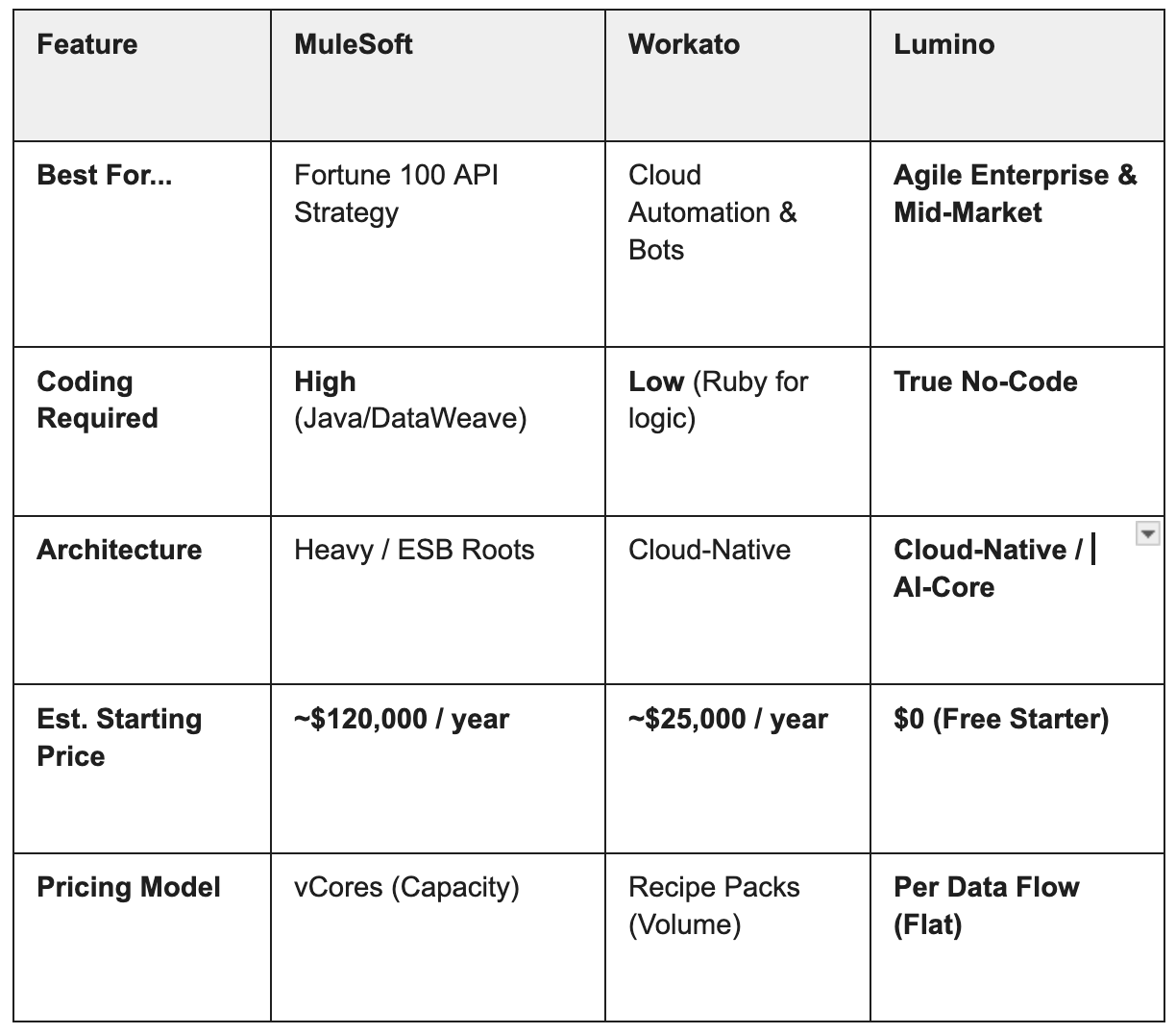
Recommendation
- Choose Workato if you have a large budget and need to automate complex human workflows (like HR onboarding bots) across a massive enterprise.
- Choose Celigo if you are a retailer running Shopify and NetSuite and want a "plug-and-play" connector with minimal customization.
- Choose Lumino if you need a flexible, intelligent platform to connect your enterprise systems without hiring developers or breaking the bank.
Ready to see the difference? Lumino offers a 30-day free trial so you can experience intelligent integration firsthand. Start building your first flow today.
Newsletter Sign-up
Sign up with your email address to receive news and updates
We respect your privacy.