Workato vs. Boomi: The 2026 Comparison Guide (And the #1 Alternative)

For many organizations, the search for an integration platform eventually becomes a philosophical debate: Do we go with the "Modern Cloud Leader" (Workato) or the "Established Hybrid Giant" (Boomi)?
Workato represents the new wave of "Enterprise Automation," promising to democratize integration with a slick, user-friendly interface. Boomi (formerly Dell Boomi) represents the proven "Hybrid" model, famous for its ability to connect cloud apps to legacy on-premise servers behind a firewall.
Choosing between them is often a choice between speed (Workato) and control (Boomi). But in 2026, do you still have to choose?
In this guide, we break down the strengths and weaknesses of both platforms—and introduce Lumino, the alternative that combines cloud-native agility with enterprise-grade hybrid power.
At a Glance: The Core Difference
- Workato is an Automation-First Platform. It excels at connecting SaaS applications and automating business workflows (like "Order-to-Cash") with a focus on speed and ease of use. It is purely cloud-native
- Boomi is a Data-First Platform. It excels at heavy ETL (Extract, Transform, Load) operations, EDI (B2B integration), and connecting to legacy on-premise systems via its "Atom" architecture. It is often favored by traditional IT teams.
Deep Dive: Workato
The "Modern Automation" Darling
Workato disrupted the market by blurring the line between integration (moving data) and automation (business logic).
Where Workato Wins:
- Speed to Value: Workato’s "Recipe" builder is visually intuitive. Business teams can often stand up a working integration in days rather than weeks.
- Community Library: With over 500,000 community recipes, you rarely start from scratch. If you need to connect Salesforce to Slack, the template already exists.
- Workflow Automation: It goes beyond data syncs to handle complex human workflows, such as approval bots in Microsoft Teams or Slack.
Where Users Struggle:
- The "Ruby Trap": While marketed as no-code, complex data transformations in Workato often require "Formula Mode," which uses Ruby scripting. If your team doesn't know Ruby, you hit a "complexity wall" that business users can't climb.
Cost Scaling: Workato’s pricing is based on "Workspaces" and "Recipes." As you scale, costs can jump significantly. Average deals often start around $15k–$25k/year but can quickly exceed $50k+ as you add capacity.
Deep Dive: Boomi
The Hybrid Heavyweight
Boomi invented the cloud iPaaS category and remains a dominant force for complex, hybrid environments.
Where Boomi Wins:
- Hybrid Connectivity: Boomi’s "Atom" architecture allows you to deploy a runtime engine anywhere—in the cloud, on your own server, or even on an edge device. This is critical for connecting to legacy ERPs (SAP, Oracle) behind a firewall.
- B2B/EDI Strength: Boomi is a powerhouse for B2B integration (EDI), making it a favorite for manufacturing and logistics companies that need to trade documents with suppliers.
- Broad Platform: It offers modules for API Management, Master Data Management (MDM), and Flow, providing a comprehensive (if expensive) stack.
Where Users Struggle:
- "Version Lock" & Updates: Boomi pushes frequent platform updates. Users often report that these updates can break existing integrations, forcing IT teams to freeze ("lock") versions and perform manual regression testing.
Dated Interface: Compared to Workato, Boomi’s UI can feel clunky and technical. It has a steeper learning curve that often requires certified architects to navigate effectively.
The Third Option: Why IT Leaders Are Switching to Lumino
If Workato feels too expensive and "script-heavy," but Boomi feels too old-fashioned and brittle, Lumino is the modern middle ground.
Lumino delivers the Cloud Agility of Workato with the Hybrid Power of Boomi.
1. Hybrid Power without the "Atom" Headache
Boomi requires complex Atom management; Workato’s on-prem agents can be limited.
- The Lumino Difference: Lumino offers a modern Remote Agent architecture. You can securely connect to on-premise SQL or ERP databases in minutes, managed entirely from our cloud-native Designer Canvas. You get hybrid connectivity without the maintenance overhead.
2. True No-Code (No Ruby Required)
Workato forces you into Ruby for complex logic.
- The Lumino Difference: Lumino’s Rule Designer handles complex transformations (nested loops, conditionals, cross-reference lookups) visually. We believe "No-Code" means no code, ensuring your team never hits a skill barrier.
3. AI-Native Stability (No Version Lock)
Boomi updates can break flows; Workato relies on you to fix errors.
The Lumino Difference: Lumino uses Schema-Aware Validation. Our AI actively monitors data structures. If an API changes, our Log Analyzer detects the break and provides plain-language remediation steps. We solved "Version Lock" by making the platform smart enough to adapt.
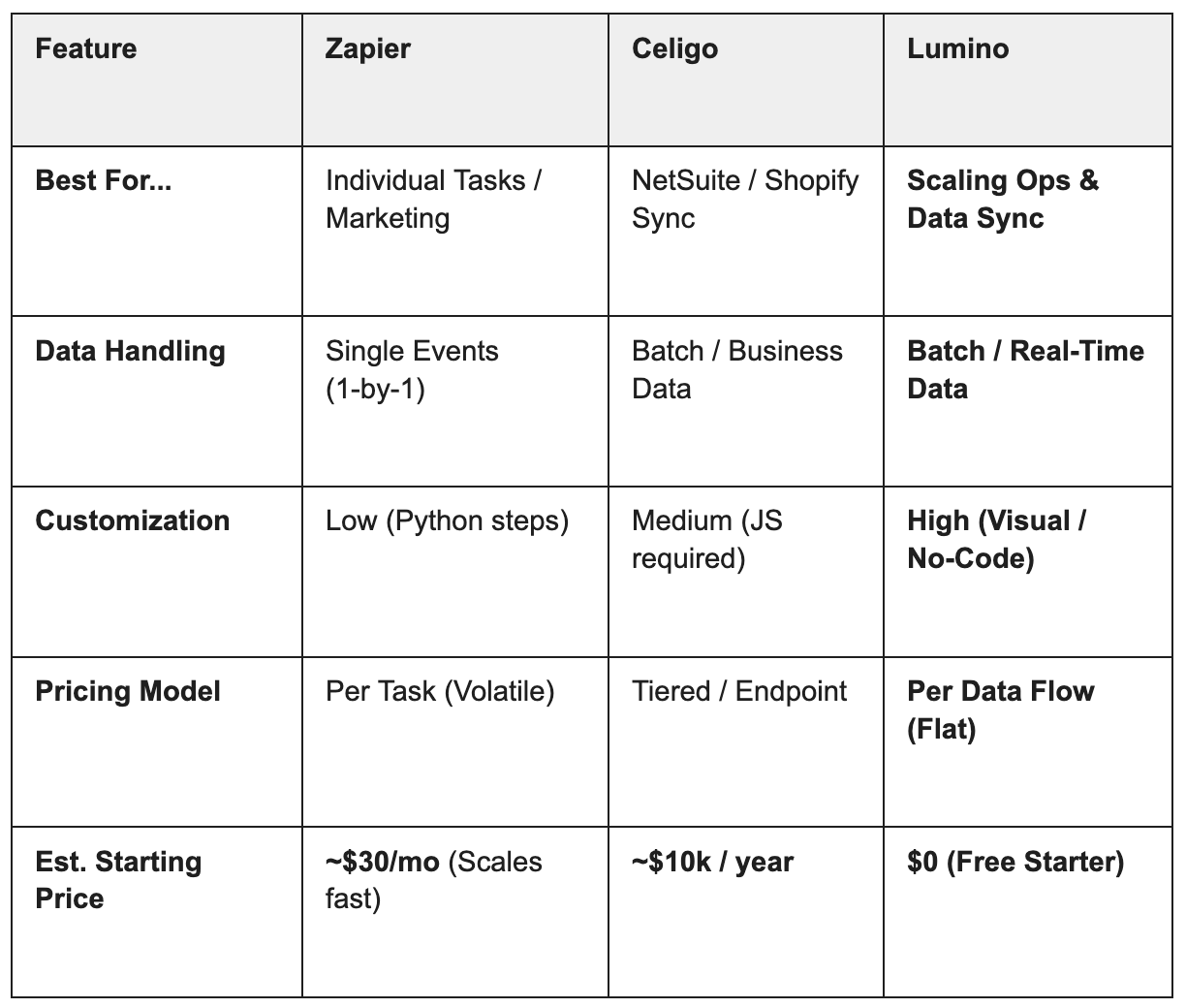
Comparison Summary
Recommendation
- Choose Zapier for personal productivity or simple marketing triggers (e.g., "Lead $\rightarrow$ Slack").
- Choose Celigo if you are a NetSuite shop looking for a "set it and forget it" template for your e-commerce store.
Choose Lumino if you are a growing business that needs to move high volumes of data across multiple systems without getting punished by per-task pricing or stuck in rigid templates.
Ready to see the difference? Lumino offers a 30-day free trial so you can experience intelligent integration firsthand. Start building your first flow today.
Newsletter Sign-up
Sign up with your email address to receive news and updates
We respect your privacy.