The Hidden Cost of OT/IT Integration Gaps in Manufacturing

The Real Cost of a Disconnected Shop Floor (And Why It Never Shows Up on the Balance Sheet)
If you asked your CFO how much your OT/IT integration gap is costing you, they probably couldn’t answer. Not because they’re not paying attention, but because that cost doesn’t appear on any report they’re looking at.
It doesn’t show up as a line item called “integration gap.” It shows up as unrealized efficiency. Downtime you couldn’t predict. Labor hours that disappear into data entry. An ERP investment that keeps underperforming relative to what it was supposed to deliver.
These costs are real. They compound year over year. And for most manufacturers, they’re large enough that making them visible changes the conversation entirely.
This article puts numbers to four cost categories that most manufacturers never connect to their shop floor connectivity decisions.
Cost 1: The Downtime You Could Have Seen Coming
Unplanned downtime is the most visceral manufacturing cost because you feel it immediately. Production stops. Labor sits idle. Customer commitments get at risk.
According to Siemens’ 2024 True Cost of Downtime report, unscheduled downtime costs the world’s 500 largest manufacturers approximately $1.4 trillion annually, equivalent to 11% of their revenues.¹ ABB’s research across 3,200 global plant maintenance leaders found that two-thirds of plants experience unplanned downtime at least once a month, at an average cost of $125,000 per hour.²
The direct connection to OT/IT integration is this: equipment failures don’t happen without warning. They happen when warnings go unnoticed.
Every piece of industrial equipment generates continuous signal data. Vibration patterns. Temperature readings. Cycle time drift. Pressure variance. These are the early indicators of impending failure, and they exist in your devices right now. What most manufacturers don’t have is a path for that data to reach a system that can analyze it and trigger a response before the failure occurs.
Predictive maintenance requires real-time device data. Without the integration layer connecting devices to analytics systems, the data stays trapped at the edge. You find out the machine is failing when it stops.
$129M
Average annual downtime cost for a large manufacturing plant, up 65% since 2019¹
Manufacturers that have closed this integration gap have reduced unplanned downtime by 35 to 50% through predictive maintenance, and extended asset lifespan by 20 to 40%.³ For a plant currently absorbing $129M annually in downtime costs, even the low end of that range represents tens of millions in recoverable losses.
Cost 2: The Labor Doing Nothing You’d Recognize as Useful
The second cost is slower and quieter, which makes it more dangerous.
When shop floor devices can’t send data automatically to enterprise systems, someone has to move that data manually. Operators log production counts at shift end. Quality technicians transcribe inspection results into spreadsheets. Maintenance staff enter equipment status updates into the ERP hours after the events occurred.
In isolation, each of those tasks seems small. Across an operation, they add up fast.
A facility with 100 production operators running three shifts, where each operator spends 30 minutes per shift on manual data entry, consumes 150 hours of labor every single day on non-value-added work. Annualized, that’s the equivalent of 26 full-time employees doing nothing but moving data between systems that should be connected.⁴
Those employees are already on payroll. Their labor is already budgeted. It just happens to be allocated to a task that integration would eliminate. Because it’s embedded in shift labor costs rather than tagged to a root cause, it’s effectively invisible.
For a three-facility manufacturer running the same model, that’s roughly 80 FTE-equivalents. The integration gap that created that situation costs money every single day and appears on no financial report.
Cost 3: The ERP Value You Paid For But Aren’t Getting
ERP implementations at manufacturing scale typically run $2 million at the low end and well over $10 million when you include professional services, customization, training, and organizational change management. The ROI case that justified that investment assumed an integrated operation.
It assumed production data flowing into planning modules in real time. Inventory counts that reflect what’s actually on the floor. Equipment status that informs maintenance scheduling. Quality data that updates downstream processes as events occur.
When floor devices aren’t connected, none of that works as designed. Leadership is making scheduling decisions against data that’s hours or days old. The inventory module is tracking what someone entered manually on the last shift. The maintenance module has no live signal from the equipment it’s supposed to track.
You’ve paid for an integrated system. You’re running a manual one.
Enterprise integration solutions, when properly implemented, deliver an average ROI of 413% with a four-month payback period.µ The gap between that potential and what most manufacturers are actually realizing from their ERP investment is a quantifiable number. For most large implementations, it represents hundreds of thousands to millions of dollars annually in unrealized value from a capital investment that’s already been made.
Cost 4: The Competitive Distance You’re Falling Behind
The first three costs are quantifiable. This one is harder to put on a spreadsheet but may be the most consequential.
Manufacturers who solve the OT/IT integration problem gain access to capabilities that require connected data. Predictive maintenance. Real-time production optimization. AI-driven quality control. Dynamic scheduling that adjusts to actual floor conditions rather than planned ones.
These capabilities compound. A manufacturer who implements predictive maintenance cuts downtime costs and reinvests that margin into further operational improvements. A manufacturer who has real-time production visibility can make faster, better decisions than one who’s working from yesterday’s data. The gap between them widens every quarter.
Gartner forecasts that 75% of G2000 manufacturers will implement IT/OT integration strategies, achieving 15 to 20% operational cost savings as a result.¶ For a manufacturer with $500 million in annual operating costs, that’s $75 to $100 million in potential savings. The manufacturers in that 75% aren’t standing still. They’re pulling ahead.
What the Full Picture Looks Like
For a large manufacturing enterprise with multiple facilities, these four cost categories add up to a number that tends to change the internal conversation about integration priority.
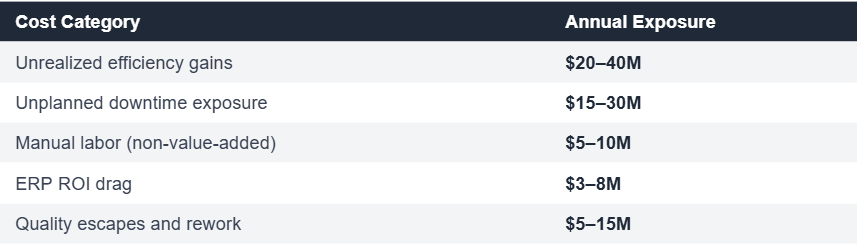
Most of these costs are invisible on financial statements because they represent unrealized potential rather than discrete expenses. That’s exactly why they persist.
What Making it Visible Actually Changes
The reason most manufacturers don’t have this conversation is that nobody has surfaced the number. Operations leaders know the workarounds exist. IT leaders know the backlog is full of integration tickets. Finance sees the ERP ROI that’s lower than projected. Nobody has connected those dots into a single annual cost figure.
When that number exists, it becomes a business case. It answers the “why now?” question that every integration project eventually faces. It shifts the conversation from “we should probably fix this at some point” to “we’re spending $X million per year on the status quo.”
That’s a different conversation to have with a CFO than a technology roadmap discussion.
Want to Put Your Numbers In?
Run the OT/IT Integration Cost Calculator
The calculator takes about 90 seconds. Enter your floor headcount, shift structure, downtime hours, and revenue per production hour. It produces a cost estimate specific to your operation across all four cost categories in this article.
Calculate my integration gap cost →
Download the OT/IT Integration Playbook
This article is the third in a three-part series. The full playbook covers the ERP gap, the market landscape, and a practical evaluation framework for assessing your integration readiness.
Sources
1 Siemens, “The True Cost of Downtime 2024.” Unscheduled downtime costs the world’s 500 largest companies approximately $1.4 trillion annually (11% of revenues). Average large plant loses $129 million annually, up 65% from 2019. https://assets.new.siemens.com/siemens/assets/api/uuid:1b43afb5-2d07-47f7-9eb7-893fe7d0bc59/TCOD-2024_original.pdf
2 ABB, Value of Reliability Report, 2024. Survey of 3,200 global plant maintenance leaders; two-thirds experienced unplanned downtime at least monthly, at an average cost of $125,000/hour. https://new.abb.com/news/detail/129763/industrial-downtime-costs-up-to-500000-per-hour-and-can-happen-every-week
3 Nucleus Research, “Quantifying the Value of Predictive Maintenance,” 2023. Predictive maintenance initiatives reduce downtime by 35–50% and extend asset lifespan by 20–40%. https://nucleusresearch.com/research/single/quantifying-the-value-of-predictive-maintenance/
4 Derived calculation: 100 operators × 0.5 hrs × 3 shifts × 250 days ÷ 2,080 working hrs/yr = 26 FTE equivalents. Based on publicly available manufacturing labor benchmarks.
5 Informatica, “From Investment to Return: Is Your iPaaS Delivering a 413% ROI?” https://www.informatica.com/blogs/from-investment-to-return-is-your-ipaas-delivering-a-413-roi.html
6 Gartner forecast cited in Smart Industry, “IT-OT Convergence as a Driver for Manufacturing Innovation,” September 2025. https://www.smartindustry.com/benefits-of-transformation/it-ot-convergence/blog/55318152/it-ot-convergence-as-a-driver-for-manufacturing-innovation
Newsletter Sign-up
Sign up with your email address to receive news and updates
We respect your privacy.