MuleSoft vs. Boomi: The 2026 Comparison Guide (And the #1 Alternative)

When large enterprises look for an integration platform (iPaaS), the conversation almost always starts with the two titans of the industry: MuleSoft (owned by Salesforce) and Boomi.
Both platforms are industry standards, trusted by the Fortune 500 to handle massive transaction volumes. But for organizations that aren't quite at the scale of a global bank, choosing between them often feels like a choice between "too expensive" and "too complex."
In this guide, we’ll compare the strengths of MuleSoft and Boomi—and introduce Lumino, the agile challenger delivering enterprise power without the legacy friction.
At a Glance: The Core Difference
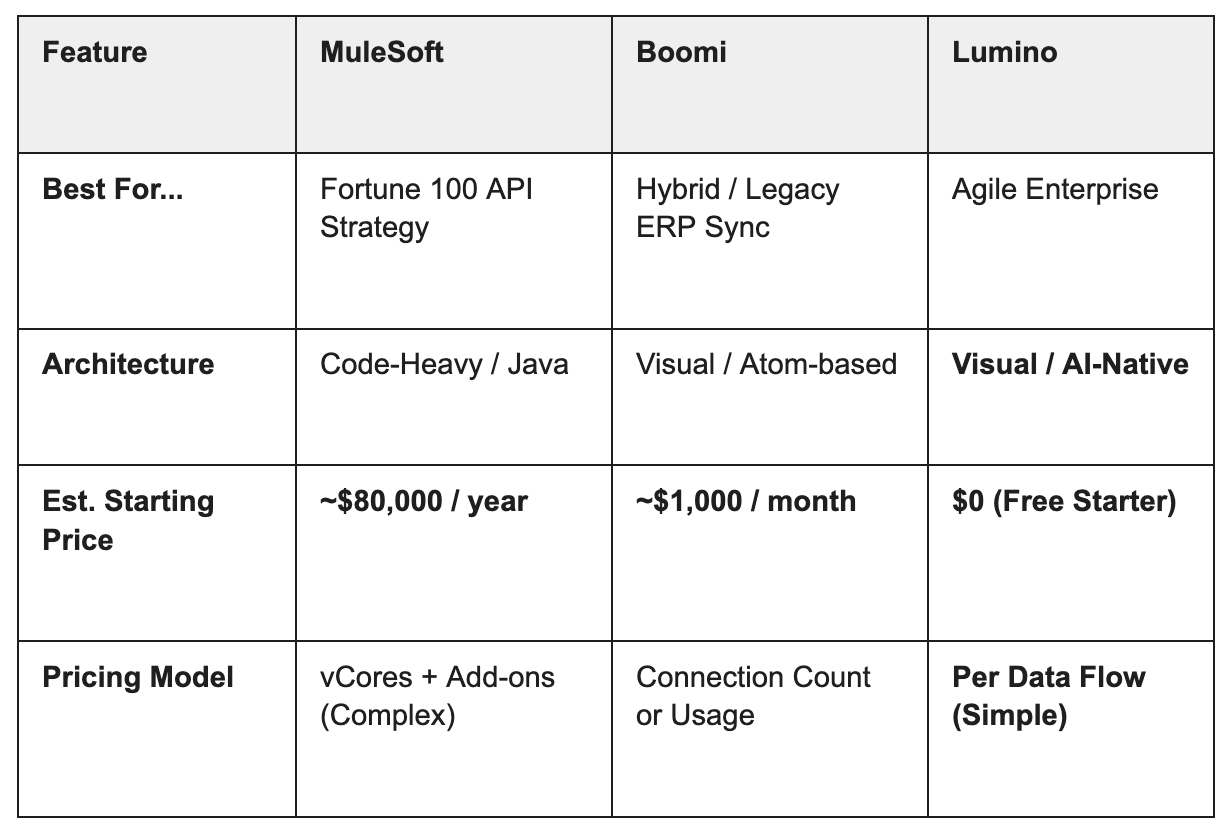
- MuleSoft (Anypoint Platform) is the gold standard for API-led connectivity. It is designed for massive organizations that want to treat every integration as a reusable API product. It is a powerful, but developer-heavy tool.
- Boomi is the pioneer of cloud-native iPaaS. It excels at hybrid integration (connecting cloud apps to on-premise systems) and is generally seen as faster to deploy than MuleSoft, though it still suffers from "version lock" and maintenance overhead.
Deep Dive: Mulesoft
The "API-First" Powerhouse
MuleSoft is best known for its "Application Network" vision. It allows large IT teams to build, manage, and secure APIs at a massive scale.
Where MuleSoft Wins:
- API Management: If your strategy relies on publishing internal APIs for other teams to consume, MuleSoft’s API management lifecycle is unmatched.
- Salesforce Synergy: Being owned by Salesforce, it offers deep, native integration for Salesforce-heavy environments.
Where Users Struggle:
- Total Cost of Ownership: MuleSoft is notoriously expensive. Licensing often starts around $80k/year and climbs rapidly with "vCores" and add-on modules.
Implementation Speed: Projects are measured in months or quarters, not days. It requires certified developers, making it overkill for agile teams that need to move fast.
Deep Dive: Boomi
The Hybrid Integration Workhorse
Boomi offers a purely visual drag-and-drop interface and is famous for its "Atom" architecture, which allows you to run integrations anywhere (cloud or on-prem).
Where Boomi Wins:
- Hybrid Connectivity: Boomi’s local "Atoms" make connecting to behind-the-firewall ERPs (like SAP or Oracle) relatively painless.
- Crowdsourced Intelligence: Its "Boomi Suggest" feature uses community data to recommend mappings, speeding up standard integrations.
Where Users Struggle:
- "Version Lock" & Updates: Users often report frustration with Boomi’s update cycle, where forced updates can break existing flows or require manual testing/intervention.
- Lack of Native AI: While Boomi has community suggestions, it lacks the deep, embedded AI for error remediation found in modern platforms.
The Third Option: Why Agile Enterprises Are Choosing Lumino
If MuleSoft is "overkill" for your budget, and Boomi feels like "legacy software" that’s hard to maintain, Lumino is the modern alternative.
Lumino delivers 85% of MuleSoft’s capability with only 20% of the effort. It is designed for the "Agile Enterprise"—organizations that need robust security and throughput but want the speed of a no-code platform.
1. Enterprise Agility (No "Certified Developer" Required)
MuleSoft requires Java developers; Boomi requires architects.
- The Lumino Difference: Lumino’s Designer Canvas is built for both IT and Ops. You get enterprise-grade features (like hybrid on-premise agents and API management) in a visual interface that lets you launch integrations in days, not months.
2. AI-Native Stability
Boomi’s "intelligence" is largely based on crowd-sourced templates. Lumino is built on a modern AI stack.
- The Lumino Difference: We use active Schema-Aware Validation. Lumino learns your data structure in real-time. If an API field changes, Lumino’s Log Analyzer flags the specific break and suggests the fix in plain English, drastically reducing maintenance downtime.
3. Transparent, Scalable Pricing
MuleSoft and Boomi are famous for complex pricing models (vCores, connection counts) that punish you for growing.
The Lumino Difference: Lumino offers a predictable subscription model based on Data Flows. You know exactly what you’re paying for, and you don’t get penalized for scaling volume.
Comparison Summary
Recommendation
- Choose Workato if you have a large budget and need to automate complex human workflows (like HR onboarding bots) across a massive enterprise.
- Choose Celigo if you are a retailer running Shopify and NetSuite and want a "plug-and-play" connector with minimal customization.
- Choose Lumino if you need a flexible, intelligent platform to connect your enterprise systems without hiring developers or breaking the bank.
Ready to see the difference? Lumino offers a 30-day free trial so you can experience intelligent integration firsthand. Start building your first flow today.
Newsletter Sign-up
Sign up with your email address to receive news and updates
We respect your privacy.