Jitterbit vs. MuleSoft: The 2026 Comparison Guide (And the #1 Alternative)

For over a decade, companies deeply invested in the Salesforce ecosystem have faced a binary choice for integration.
If you had a massive budget, you bought MuleSoft (acquired by Salesforce in 2018), the undisputed king of enterprise API management. If you needed similar connectivity but couldn't afford the six-figure price tag, you bought Jitterbit, the pragmatic, cost-effective alternative.
But in 2026, the gap between "Premium" and "Value" has shifted. MuleSoft remains powerful but heavy. Jitterbit remains cheaper but is starting to show its age.
In this guide, we compare these two veterans of the Salesforce world—and introduce Lumino, the AI-native platform that offers a modern upgrade to both.
At a Glance: The Core Difference
- MuleSoft is the Enterprise Standard. It is an "API-Led" platform designed for Fortune 500 companies to build, manage, and secure complex networks of internal APIs. It requires a dedicated team of developers.
- Jitterbit is the Mid-Market Alternative. It focuses on practical, rapid API creation and data syncing, particularly for Salesforce and NetSuite. It is designed to be "low-code" but often relies on scripting for complex tasks.
Deep Dive: Mulesoft
The "Heavy Artillery"
MuleSoft’s Anypoint Platform is a beast. It allows you to treat every integration as a reusable product.
Where MuleSoft Wins:
- API Lifecycle: It doesn't just build APIs; it manages them (gateways, security policies, monetization). If you are building a bank, you use MuleSoft.
- Salesforce Native: As a Salesforce company, its connectors are first-party. It integrates deeply with the Salesforce "Customer 360" vision.
- Unlimited Power: With its Java-based foundation (DataWeave), there is virtually no technical scenario it cannot handle—if you have the coding talent.
Where Users Struggle:
- The "MuleSoft Tax": It is one of the most expensive tools on the market. Licensing often starts at ~$80,000/year and climbs rapidly based on "vCores" (computing power). You pay for capacity, not just value.
Complexity: Projects are measured in months. You need certified architects. It is overkill for agile teams that just need to sync Orders to ERP.
Deep Dive: Jitterbit
The "Good Enough" Workhorse
Jitterbit Harmony made its name by offering 80% of MuleSoft’s connectivity for 20% of the price.
Where Jitterbit Wins:
- API Creation: Like MuleSoft, Jitterbit excels at wrapping legacy databases in APIs, but it makes the process much faster and simpler.
- Salesforce Focus: Before MuleSoft was acquired, Jitterbit was the go-to for Salesforce data loading. It is still excellent for bulk data movement.
- Pricing: Jitterbit is far more accessible, with entry tiers around **~$1,000/month** (~$12k/year). It fits the mid-market budget perfectly.
Where Users Struggle:
- Dated Experience: Jitterbit has been around a long time, and it looks like it. Users frequently mention that the interface feels dated compared to modern SaaS tools.
The Scripting Trap: While marketed as low-code, Jitterbit users often find themselves writing proprietary scripts to handle complex data logic, creating a hidden technical debt.
The Third Option: Why Teams Are Modernizing with Lumino
If MuleSoft is too expensive to justify, and Jitterbit feels like buying software from 2015, Lumino is the modern evolution.
Lumino delivers the Price Point of Jitterbit with the Enterprise Power of MuleSoft—wrapped in a 2026 Consumer-Grade Experience.
1. Enterprise Power, Mid-Market Price
MuleSoft charges for "vCores"; Jitterbit charges for endpoints.
- The Lumino Difference: Lumino delivers 85% of MuleSoft's capabilities for 20% of the effort. Our Flat Subscription model means you get enterprise throughput without the six-figure contract.
2. True No-Code (No DataWeave, No Scripts)
MuleSoft requires Java skills; Jitterbit requires scripting.
- The Lumino Difference: Lumino’s Rule Designer allows you to build complex logic visualy. We believe you shouldn't need to be a developer to be an "Architect".
3. AI-Native Maintenance
Jitterbit and MuleSoft are tools you have to manage.
The Lumino Difference: Lumino is an active partner. Our Log Analyzer uses AI to monitor your Salesforce integrations in real-time. If a sync fails, it tells you why in plain English, reducing your dependency on support tickets.
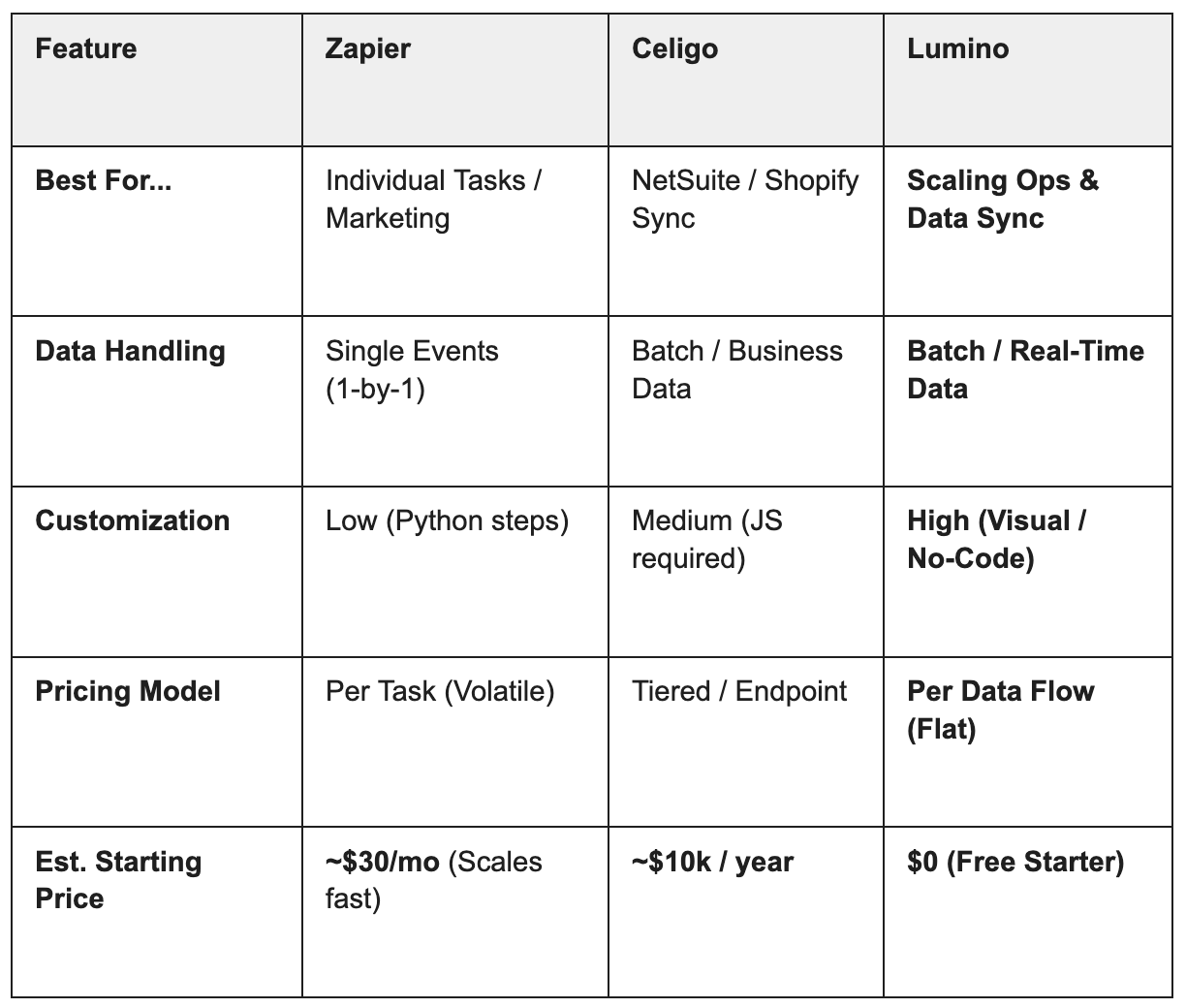
Comparison Summary
Recommendation
- Choose MuleSoft if you are a massive enterprise building a complex, governed "Application Network" and budget is no object.
- Choose Jitterbit if you are a budget-conscious IT team that specifically needs to wrap legacy databases in APIs and have scripting skills on hand.
- Choose Lumino if you want the connectivity of MuleSoft and the price of Jitterbit, but with a modern, AI-powered interface that your entire team can actually use.
Ready to see the difference? Lumino offers a 30-day free trial so you can experience intelligent integration firsthand. Start building your first flow today.
Newsletter Sign-up
Sign up with your email address to receive news and updates
We respect your privacy.