Jitterbit vs. Boomi: The 2026 Comparison Guide (And the #1 Alternative)

For over a decade, the mid-market integration landscape has been dominated by two steady names: Jitterbit and Boomi.
If you were shopping for an iPaaS (Integration Platform as a Service) five years ago, these were likely the only two options on your shortlist that balanced enterprise power with a manageable price tag. Boomi defined the cloud-native category, while Jitterbit carved out a reputation as the pragmatic, Salesforce-centric alternative.
But entering 2026, the question has changed. It is no longer just about which legacy tool is better; it is about whether you should be buying legacy software at all.
In this guide, we compare Jitterbit and Boomi to see how they stack up in the modern era—and introduce Lumino, the AI-native platform designed to replace them both.
At a Glance: The Core Difference
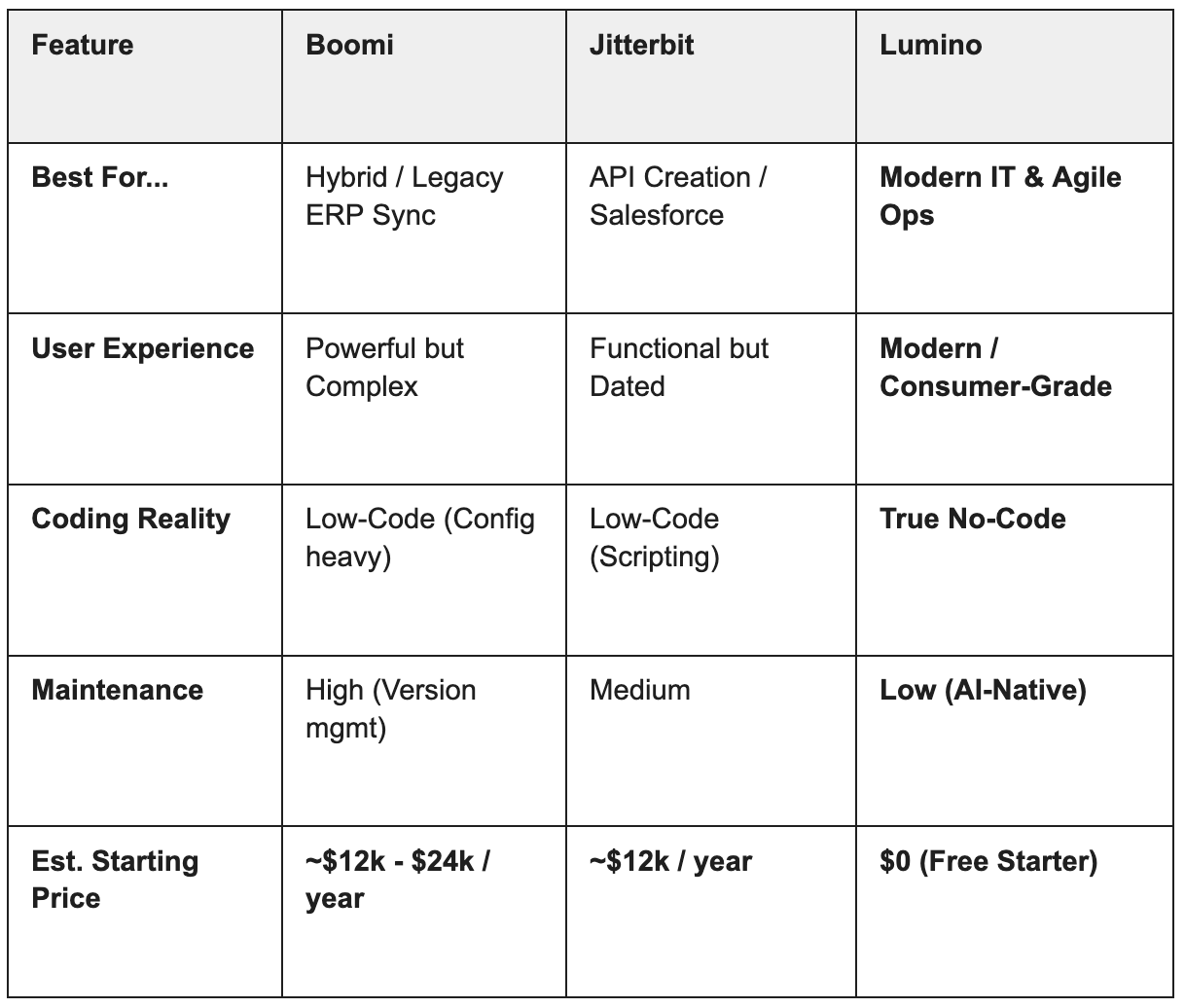
- Boomi is the Hybrid Integration Leader. Famous for its "Atom" architecture, it excels at connecting cloud apps to on-premise legacy systems (like SAP or Oracle) behind a firewall. It is a broad, powerful platform used by large enterprises.
- Jitterbit is the Pragmatic API Builder. While it handles general integration, its superpower is quickly creating APIs from existing data sources, particularly within the Salesforce ecosystem. It is generally viewed as a lower-cost alternative to Boomi.
Deep Dive: Boomi
The "Atom-Sphere" Giant
Boomi (formerly Dell Boomi) is a massive platform. It covers everything from EDI (B2B integration) to Master Data Management (MDM).
Where Boomi Wins:
- Hybrid Connectivity: Boomi’s patented "Atom" technology allows you to run integrations anywhere—in their cloud, your cloud, or on an on-premise server. This is critical for manufacturing and logistics companies with physical servers.
- Breadth of Platform: Boomi isn't just integration; it offers modules for API Management, Flow (workflow), and Data Cataloging, making it a "one-stop-shop" if you have the budget.
- Community Intelligence: Boomi Suggest was one of the first AI tools in the market, using crowd-sourced data to recommend field mappings.
Where Users Struggle:
- "Version Lock": Boomi pushes frequent platform updates. Users often report anxiety around these release windows, as updates can sometimes break existing connections, requiring manual testing and "version lock" management.
Complexity & Cost: As Boomi has grown, so has its complexity. Navigating the interface can feel overwhelming, and pricing often starts around ~$1,000–$2,000/month, escalating quickly with additional connectors and endpoints.
Deep Dive: Jitterbit
The Salesforce Specialist
Jitterbit Harmony is a veteran tool that focuses on simplicity for technical teams. It is a staple in the mid-market, particularly for companies integrating NetSuite, Salesforce, and older databases.
Where Jitterbit Wins:
- API Creation: Jitterbit makes it exceptionally easy to take a database (like an old SQL server) and wrap it in a REST API so modern apps can talk to it.
- Salesforce & NetSuite: Jitterbit has deep roots in these ecosystems and offers strong "Citizen Integrator" templates for these specific tools.
- Price: Jitterbit generally undercuts Boomi. Entry-level tiers can be found for ~$1,000/month, making it a popular choice for budget-conscious IT teams.
Where Users Struggle:
- The Scripting Barrier: While the UI looks visual, advanced transformations often require Jitterbit’s proprietary scripting language. It is a "Low-Code" tool that frequently demands a developer’s mindset.
Dated Interface: Long-time users note that Jitterbit’s design feels like software from the 2010s. It lacks the modern, fluid UX of newer SaaS platforms, making adoption harder for non-technical staff.
The Third Option: Why Enterprises Are Modernizing with Lumino
If Boomi feels too heavy and Jitterbit feels too dated, Lumino is the 2026 upgrade.
Lumino replaces the friction of legacy tools with AI-Native Intelligence. We don't just connect endpoints; we understand the data flowing between them.
1. Modern Architecture (No Version Lock)
Boomi fights with update cycles; Jitterbit feels aged.
- The Lumino Difference: Lumino is a modern, cloud-native platform with a Consumer-Grade UX. Updates are seamless, and the interface is designed for the 2026 workforce—intuitive, fast, and requiring zero training to navigate.
2. True No-Code (No Proprietary Scripts)
Jitterbit often forces you to script.
- The Lumino Difference: Lumino’s Rule Designer allows you to handle complex logic, loops, and data transformation visually. You get the flexibility of code without the technical debt.
3. Active AI Intelligence
Boomi relies on passive, crowd-sourced suggestions.
The Lumino Difference: Lumino’s Log Analyzer actively monitors your integrations. When an error occurs (like a data mismatch), our AI diagnoses the root cause and provides plain-language remediation steps. It’s like having a support engineer built into the platform.
Comparison Summary
Recommendation
- Choose Workato if you have a large budget and need to automate complex human workflows (like HR onboarding bots) across a massive enterprise.
- Choose Celigo if you are a retailer running Shopify and NetSuite and want a "plug-and-play" connector with minimal customization.
- Choose Lumino if you need a flexible, intelligent platform to connect your enterprise systems without hiring developers or breaking the bank.
Ready to see the difference? Lumino offers a 30-day free trial so you can experience intelligent integration firsthand. Start building your first flow today.
Newsletter Sign-up
Sign up with your email address to receive news and updates
We respect your privacy.