Celigo vs. Zapier: The 2026 Comparison Guide (And the #1 Alternative)

For fast-growing businesses—especially in e-commerce and SaaS—integration usually follows a predictable path.
You start with Zapier to handle simple triggers ("When a new Shopify order comes in, add it to a Google Sheet"). But as volume grows and workflows get complex, Zapier’s bills explode and its capabilities hit a wall. That’s when teams often look at Celigo, a more robust platform designed to connect core business apps like NetSuite and Salesforce.
But is Celigo the right graduation step? Or is it jumping from "too simple" to "too rigid"?
In this guide, we compare Celigo and Zapier—and introduce Lumino, the platform that offers the ease of a simple tool with the power of an enterprise solution.
At a Glance: The Core Difference
- Zapier is a Task Automation Tool. It is designed for individuals and small teams to create linear "If This, Then That" workflows between thousands of apps. It connects events (e.g., "New Lead").
- Celigo is an iPaaS (Integration Platform as a Service). It is designed for businesses to sync data (e.g., "Sync all Inventory levels every 15 minutes"). It excels at connecting ERPs and E-commerce platforms via pre-built templates.
Deep Dive: Zapier
The "Universal Remote" for SaaS
Zapier is likely the first automation tool you ever used. Its "Trigger $\rightarrow$ Action" model is universally understood.
Where Zapier Wins:
- The Long Tail: With 6,000+ connectors, if a SaaS tool exists, Zapier connects to it. It is unmatched for niche marketing tools.
- Instant Gratification: You can build a working Zap in 5 minutes. No training, no sales calls, just sign up and go.
- Personal Productivity: It is excellent for individual tasks (e.g., "Save my Gmail attachments to Dropbox").
Where Users Struggle:
- The "Task" Tax: Zapier charges per action. If you sync 10,000 orders a month, and each order requires 5 steps, your bill skyrockets. It punishes high-volume data movement.
- No Real "Data" Handling: Zapier moves events one by one. It doesn't handle "batch" updates well (e.g., "Update 5,000 prices at once"), making it unsuitable for core business operations like inventory sync.
Fragility: If an API changes or a Zap fails, you often lose that data forever unless you pay for premium "Replay" features.
Deep Dive: Celigo
The E-Commerce Upgrade
Celigo is often the next step for companies running on NetSuite or Acumatica. It moves from "tasks" to "business processes."
Where Celigo Wins:
- Pre-Built Integration Apps: Celigo sells fully managed templates (e.g., "Shopify to NetSuite") that handle complex scenarios like refunds and fulfillment out of the box.
- Data Volume: Unlike Zapier, Celigo is built to move thousands of records at a time. It is a true business logic engine.
- Error Management: It has a dashboard to retry failed errors, which is critical for financial data.
Where Users Struggle:
- The "Template Trap": Celigo is great if you stick to the template. G2 reviews note that customization is difficult; stepping outside the pre-packaged flows often requires JavaScript knowledge.
Jump in Complexity: Moving from Zapier to Celigo is a shock. You go from a simple linear builder to a complex interface with flows, exports, and imports. It often requires a consultant to set up correctly.
The Third Option: Why Scaling Teams Are Choosing Lumino
If Zapier is "too toy-like" for your data, but Celigo feels "too heavy" and template-locked, Lumino is the modern alternative.
Lumino provides the Volume Handling of Celigo with the No-Code Simplicity of Zapier.
1. High Volume without the High Bill
Zapier taxes every step; Celigo charges by endpoint.
- The Lumino Difference: Lumino offers a Flat Subscription based on Data Flows. Whether you sync 100 orders or 100,000, your price stays predictable. It is built for scale from Day 1.
2. True No-Code Customization
Celigo forces you into JavaScript for custom logic; Zapier forces you into Python steps.
- The Lumino Difference: Lumino’s Rule Designer lets you build complex logic (like "If inventory < 10, check warehouse B, else update status") visually. You get the power of custom scripting without writing code.
3. Intelligent Data Integrity
Zapier loses data; Celigo requires manual error management.
The Lumino Difference: Lumino is AI-Native. Our Log Analyzer watches your data flows. If an order fails to sync, it tells you why (e.g., "Invalid SKU format") and helps you fix it instantly. It ensures your financial data is accurate without the manual headache.
Comparison Summary
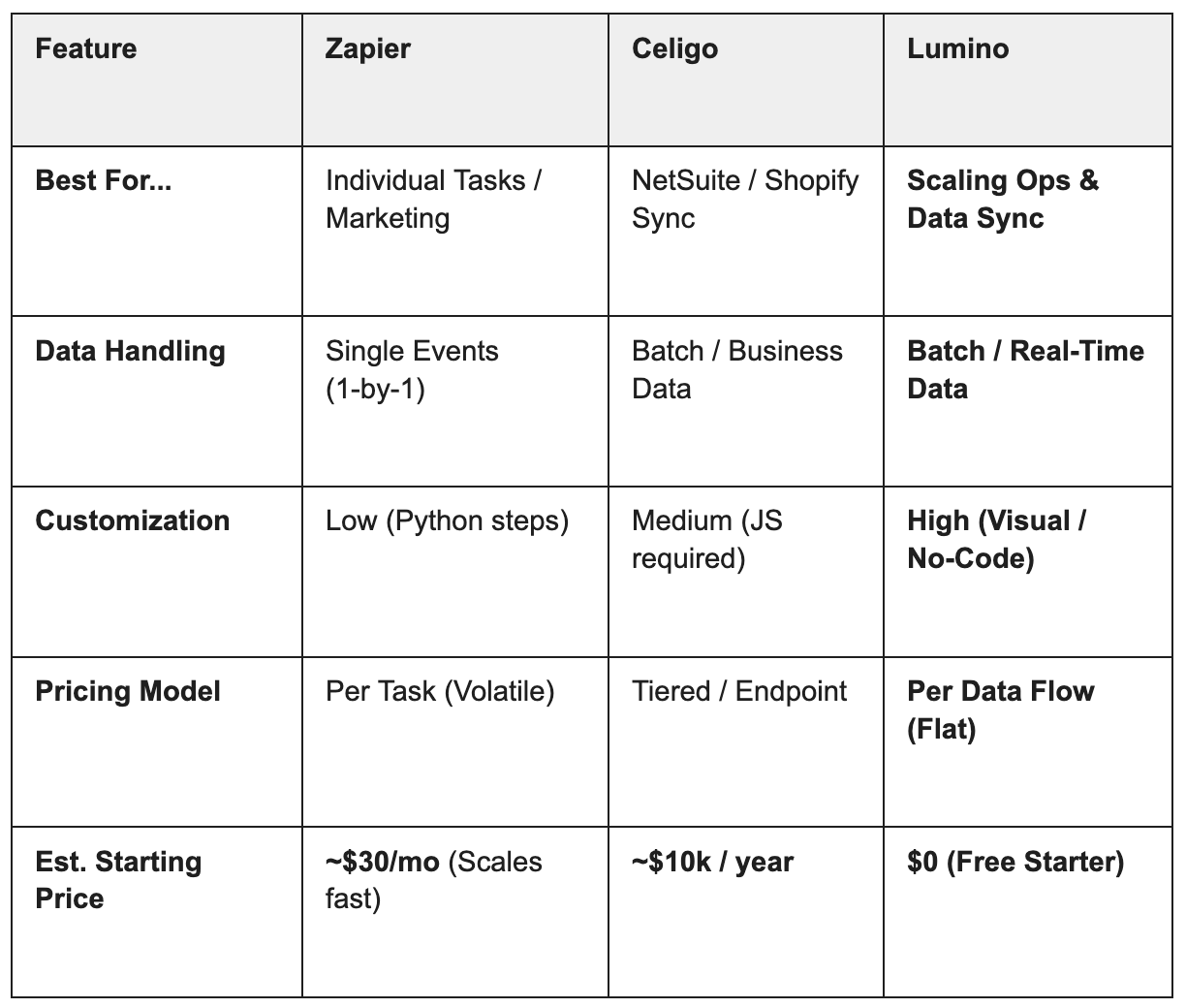
Recommendation
- Choose Zapier for personal productivity or simple marketing triggers (e.g., "Lead $\rightarrow$ Slack").
- Choose Celigo if you are a NetSuite shop looking for a "set it and forget it" template for your e-commerce store.
Choose Lumino if you are a growing business that needs to move high volumes of data across multiple systems without getting punished by per-task pricing or stuck in rigid templates.
Ready to see the difference? Lumino offers a 30-day free trial so you can experience intelligent integration firsthand. Start building your first flow today.
Newsletter Sign-up
Sign up with your email address to receive news and updates
We respect your privacy.