Celigo vs. Boomi: The 2026 Comparison Guide (And the #1 Alternative)

When mid-market companies outgrow simple tools and look for serious integration power, the search often lands on two distinct options: Celigo and Boomi.
On one side, you have Celigo, the darling of the modern SaaS world, famous for its pre-packaged "Integration Apps" for NetSuite and Shopify. On the other, you have Boomi, the veteran heavyweight capable of connecting anything to anything, provided you have the technical team to manage it.
Choosing between them often feels like a trade-off: Do you want speed (Celigo) or raw power (Boomi)?
In this guide, we break down these two platforms and introduce Lumino, the AI-native alternative that proves you don't have to compromise on either.
At a Glance: The Core Difference
- Celigo (integrator.io) is the "SaaS Specialist." It is built for the modern cloud stack, excelling at connecting ERPs (like NetSuite) to e-commerce and CRM tools via pre-built templates. It favors "configuration" over custom building.
Boomi is the "Hybrid Heavyweight." It is designed for complex architectures that mix cloud apps with on-premise legacy servers (like SAP behind a firewall). It favors "building from scratch" using a vast toolkit of connectors.
Deep Dive: Celigo
The "Plug-and-Play" Leader
Celigo has made a name for itself by productizing integration. Instead of asking you to build a connection, they sell you an "Integration App" that is 90% pre-built.
Where Celigo Wins:
- E-Commerce & ERP: If you run a retail business connecting Shopify/Amazon to NetSuite/Acumatica, Celigo is the market leader. Their templates for "Order-to-Cash" are robust.
- Speed to Deployment: Because you are configuring templates rather than building from a blank canvas, you can get standard flows live very quickly.
- Business User Friendly: The UI is clean and designed for operations managers, not just IT architects.
Where Users Struggle:
- Customization Limits: The "template" strength is also a weakness. G2 reviews note that when you need to step outside the pre-built logic—for example, complex data transformation or custom API handling—Celigo can feel rigid.
Enterprise Scale: While great for SaaS-to-SaaS, Celigo struggles when asked to handle heavy on-premise legacy data or massive B2B/EDI transaction volumes compared to Boomi.
Deep Dive: Boomi
The "Build Anything" Giant
Boomi invented the cloud iPaaS category. It offers a massive palette of tools to connect virtually any endpoint, no matter how old or obscure.
Where Boomi Wins:
- Hybrid Connectivity: Boomi’s "Atom" architecture allows you to deploy an agent behind your firewall, making it the superior choice for connecting to legacy on-premise databases (SQL, Oracle, SAP).
- Versatility: From API management to Master Data Management (MDM), Boomi has a module for everything. If you have a massive budget, you can build a comprehensive stack.
- Crowdsourced Suggestions: Boomi Suggest helps technical users map fields faster by leveraging community data.
Where Users Struggle:
- "Version Lock" Anxiety: Boomi pushes frequent platform updates that can sometimes break existing integrations. IT teams often have to freeze ("lock") updates to perform manual regression testing, slowing down innovation.
Cost & Complexity: Boomi is expensive (starting ~$12k–$24k/year) and complex. It requires trained architects to build and maintain, creating a bottleneck for business teams who just want data to flow.
The Third Option: Why Growing Brands Are Choosing Lumino
If Celigo feels too rigid for your custom needs, but Boomi feels too heavy and expensive to maintain, Lumino is the answer.
Lumino delivers Enterprise Power with Consumer-Grade Ease. We give you the on-premise connectivity of Boomi with the user-friendly speed of Celigo.
1. Custom Power without the "Blank Canvas" Fear
Boomi forces you to build from scratch; Celigo locks you into templates.
- The Lumino Difference: Lumino’s Designer Canvas offers the best of both. You can start with a pre-built connector (like Celigo), but our Rule Designer lets you visually customize complex logic and transformations without limits (like Boomi)—all without writing code.
2. AI-Native Stability (No Version Lock)
Boomi breaks when it updates; Celigo breaks when data changes.
- The Lumino Difference: Lumino is AI-Native. Our Schema-Aware Validation actively learns your data structures. If a Shopify API update changes a field, Lumino’s Log Analyzer detects the mismatch and guides you to the fix instantly. No version locking required.
3. Transparent, Flat Pricing
Boomi charges by endpoint/volume; Celigo has tiered caps.
The Lumino Difference: Lumino offers a simple Subscription + Data Flow model. Connect as many endpoints as you want. Push as much data as you need. We don't punish you for growth.
Comparison Summary
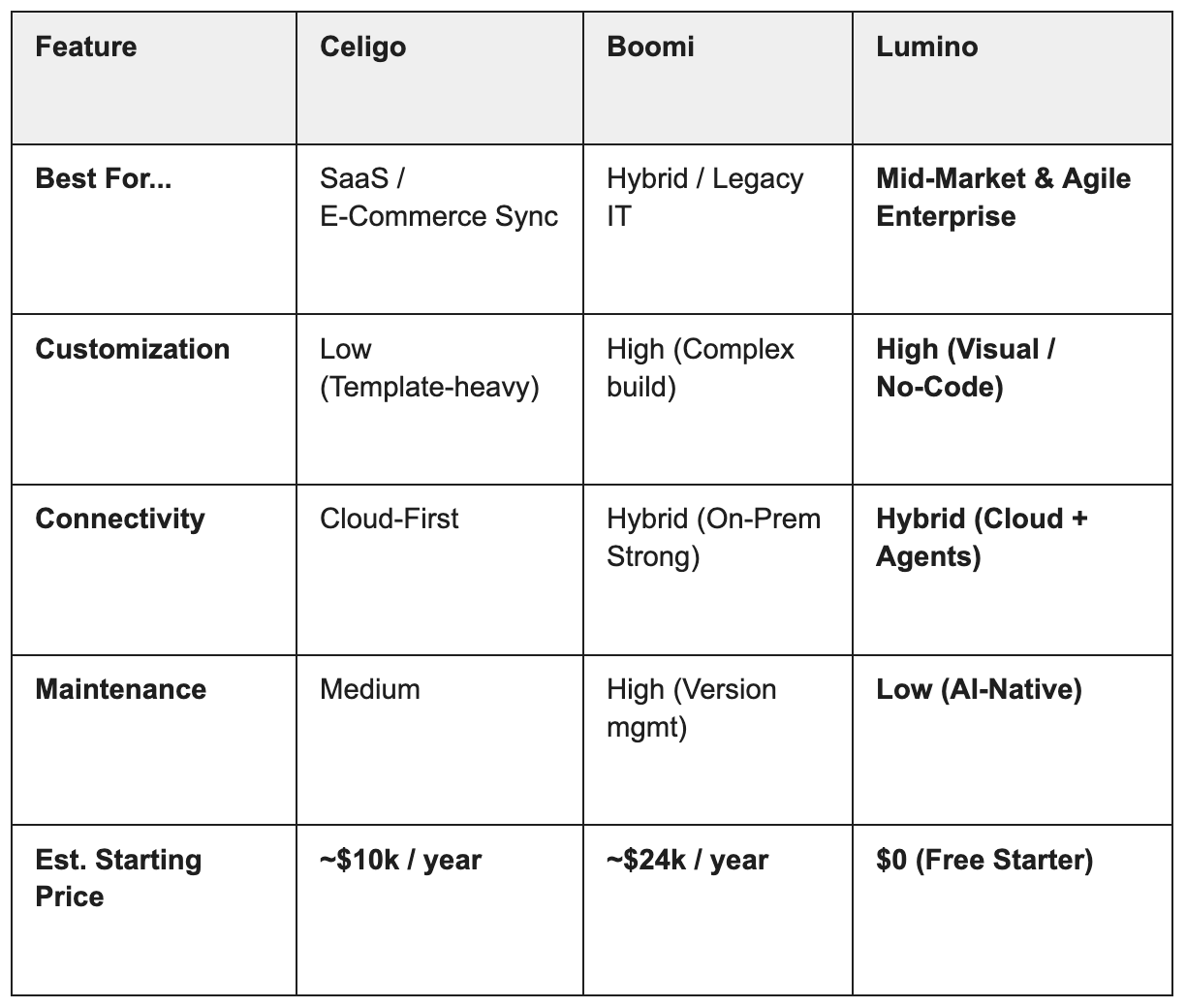
Recommendation
- Choose Workato if you have a large budget and need to automate complex human workflows (like HR onboarding bots) across a massive enterprise.
- Choose Celigo if you are a retailer running Shopify and NetSuite and want a "plug-and-play" connector with minimal customization.
- Choose Lumino if you need a flexible, intelligent platform to connect your enterprise systems without hiring developers or breaking the bank.
Ready to see the difference? Lumino offers a 30-day free trial so you can experience intelligent integration firsthand. Start building your first flow today.
Newsletter Sign-up
Sign up with your email address to receive news and updates
We respect your privacy.